
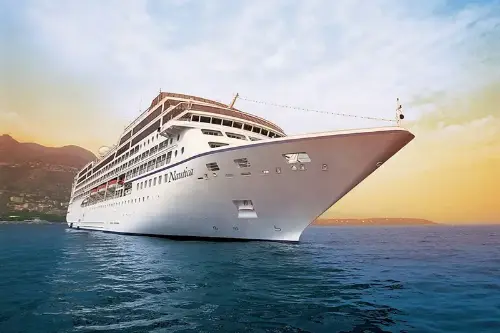
Sea cruise · 13.09.2026 – 04.11.2026 · 52 nights
Journey to eastern realms
Route and cruise information
Premium- Rome (Civitavecchia)
- Sorrento, Capri
- Messina, o. Sicily
- Valletta
- Dubrovnik
- Kotor
- Corfu
- Katakolon (Olympia)
- Santorini, Cyclades
- Piraeus (Athens)
- Selcuk
- Bodrum
- Heraklion
- Rhodes
- Limassol
- Aqaba
- Sharm el-Sheikh
- Luxor
- Jeddah
- Salalah
- Dubai
- Abu Dhabi
- Doha
- Dubai
- Mumbai (Bombay)
- Mumbai (Bombay)
- Malé
- Malé
- Galle
- Phuket
- Kuah
- Georgetown
- Kuala Lumpur
- Singapore
- Singapore
| Date | Port | Arrival | Departure |
|---|---|---|---|
| 13.09.2026 |
Rome (Civitavecchia)
Italy
|
07:00 | 17:00 |
| 14.09.2026 |
Sorrento, Capri
Italy
|
08:00 | 17:00 |
| 15.09.2026 |
Messina, o. Sicily
Italy
|
08:00 | 17:00 |
| 16.09.2026 |
Valletta
Malta
|
08:00 | 17:00 |
| 17.09.2026 |
Day at sea
|
— | — |
| 18.09.2026 |
Dubrovnik
Croatia
|
08:00 | 17:00 |
| 19.09.2026 |
Kotor
Montenegro
|
07:00 | 16:00 |
| 20.09.2026 |
Corfu
Greece
|
08:00 | 17:00 |
| 21.09.2026 |
Katakolon (Olympia)
Greece
|
07:00 | 16:00 |
| 22.09.2026 |
Santorini, Cyclades
Greece
|
10:00 | 18:00 |
| 23.09.2026 |
Piraeus (Athens)
Greece
|
05:00 | 17:00 |
| 24.09.2026 |
Selcuk
Turkey
|
08:00 | 17:00 |
| 25.09.2026 |
Bodrum
Turkey
|
08:00 | 17:00 |
| 26.09.2026 |
Heraklion
Greece
|
08:00 | 17:00 |
| 27.09.2026 |
Rhodes
Greece
|
08:00 | 16:00 |
| 28.09.2026 |
Limassol
Cyprus
|
11:00 | 18:00 |
| 29.09.2026 |
Day at sea
|
— | — |
| 30.09.2026 |
Day at sea
|
— | — |
| 01.10.2026 |
Aqaba
Jordan
|
09:00 | 23:00 |
| 02.10.2026 |
Sharm el-Sheikh
Egypt
|
08:00 | 20:00 |
| 03.10.2026 |
Luxor
Egypt
|
07:00 | 23:00 |
| 04.10.2026 |
Day at sea
|
— | — |
| 05.10.2026 |
Jeddah
Saudi Arabia
|
08:00 | 18:00 |
| 06.10.2026 |
Day at sea
|
— | — |
| 07.10.2026 |
Day at sea
|
— | — |
| 08.10.2026 |
Day at sea
|
— | — |
| 09.10.2026 |
Salalah
Oman
|
08:00 | 17:00 |
| 10.10.2026 |
Day at sea
|
— | — |
| 11.10.2026 |
Day at sea
|
— | — |
| 12.10.2026 |
Dubai
UAE
|
08:00 | 23:00 |
| 13.10.2026 |
Abu Dhabi
UAE
|
08:00 | 17:00 |
| 14.10.2026 |
Doha
Qatar
|
07:00 | 16:00 |
| 15.10.2026 |
Day at sea
|
— | — |
| 16.10.2026 |
Dubai
UAE
|
07:00 | 23:00 |
| 17.10.2026 |
Day at sea
|
— | — |
| 18.10.2026 |
Day at sea
|
— | — |
| 19.10.2026 |
Day at sea
|
— | — |
| 20.10.2026 |
Mumbai (Bombay)
India
|
06:00 | — |
| 21.10.2026 |
Mumbai (Bombay)
India
|
— | 22:00 |
| 22.10.2026 |
Day at sea
|
— | — |
| 23.10.2026 |
Day at sea
|
— | — |
| 24.10.2026 |
Malé
Maldives
|
08:00 | — |
| 25.10.2026 |
Malé
Maldives
|
— | 22:00 |
| 26.10.2026 |
Day at sea
|
— | — |
| 27.10.2026 |
Galle
Sri Lanka
|
07:00 | 14:00 |
| 28.10.2026 |
Day at sea
|
— | — |
| 29.10.2026 |
Day at sea
|
— | — |
| 30.10.2026 |
Phuket
Thailand
|
11:00 | 20:00 |
| 31.10.2026 |
Kuah
Malaysia
|
09:00 | 18:00 |
| 01.11.2026 |
Georgetown
Cayman Islands
|
08:00 | 17:00 |
| 02.11.2026 |
Kuala Lumpur
Malaysia
|
08:00 | 17:00 |
| 03.11.2026 |
Singapore
Singapore
|
08:00 | — |
| 04.11.2026 |
Singapore
Singapore
|
— | 18:00 |
-
 Day 1: 07:00–17:00
Rome (Civitavecchia) / Italy
Rome is the capital city and a special comune of Italy (named Comune di Roma Capitale). Rome also serves as the capital of the Lazio region. With 2,872,800 residents in 1,285 km2(496.1 sq mi), it is also the country's most populated comune. It is the fourth-most populous city in the European Union by population within city limits. It is the centre of the Metropolitan City of Rome, which has a population of 4,355,725 residents, thus making it the most populous metropolitan city in Italy. Rome is located in the central-western portion of the Italian Peninsula, within Lazio (Latium), along the shores of the Tiber. The Vatican City (the smallest country in the world) is an independent country inside the city boundaries of Rome, the only existing example of a country within a city: for this reason Rome has been often defined as capital of two states.
Rome's history spans 28 centuries. While Roman mythology dates the founding of Rome at around 753 BC, the site has been inhabited for much longer, making it one of the oldest continuously occupied sites in Europe. The city's early population originated from a mix of Latins, Etruscans, and Sabines. Eventually, the city successively became the capital of the Roman Kingdom, the Roman Republic and the Roman Empire, and is regarded as the birthplace of Western civilization and by some as the first ever metropolis. It was first called The Eternal City (Latin: Urbs Aeterna; Italian: La Città Eterna) by the Roman poet Tibullus in the 1st century BC, and the expression was also taken up by Ovid, Virgil, and Livy. Rome is also called the "Caput Mundi" (Capital of the World). After the fall of the Western Empire, which marked the beginning of the Middle Ages, Rome slowly fell under the political control of the Papacy, which had settled in the city since the 1st century AD, until in the 8th century it became the capital of the Papal States, which lasted until 1870. Beginning with the Renaissance, almost all the popes since Nicholas V (1447–1455) pursued over four hundred years a coherent architectural and urban programme aimed at making the city the artistic and cultural centre of the world. In this way, Rome became first one of the major centres of the Italian Renaissance, and then the birthplace of both the Baroque style and Neoclassicism. Famous artists, painters, sculptors and architects made Rome the centre of their activity, creating masterpieces throughout the city. In 1871, Rome became the capital of the Kingdom of Italy, which, in 1946, became the Italian Republic.
Rome has the status of a global city. In 2016, Rome ranked as the 14th-most-visited city in the world, 3rd most visited in the European Union, and the most popular tourist attraction in Italy. Its historic centre is listed by UNESCO as a World Heritage Site. The famous Vatican Museums are among the world's most visited museums while the Colosseum was the most popular tourist attraction in world with 7.4 million visitors in 2018. Host city for the 1960 Summer Olympics, Rome is the seat of several specialized agencies of the United Nations, such as the Food and Agriculture Organization (FAO), the World Food Programme (WFP) and the International Fund for Agricultural Development (IFAD). The city also hosts the Secretariat of the Parliamentary Assembly of the Union for the Mediterranean (UfM) as well as the headquarters of many international business companies such as Eni, Enel, TIM, Leonardo S.p.A., and national and international banks such as Unicredit and BNL. Its business district, called EUR, is the base of many companies involved in the oil industry, the pharmaceutical industry, and financial services. Rome is also an important fashion and design centre thanks to renowned international brands centered in the city. Rome's Cinecittà Studios have been the set of many Academy Award–winning movies.
-
 Day 2: 08:00–17:00
Sorrento, Capri / Italy
Sorrento is a town overlooking the Bay of Naples in Southern Italy. A popular tourist destination due to its variety of small antique shops and location on the Amalfi Coast, it can be reached easily from Naples and Pompeii as it is at the south-eastern end of the Circumvesuviana rail line. The town is most commonly known for its small shops selling an arrangement of ceramics, lacework and marquetry (woodwork).
The Sorrentine Peninsula has views of Naples, Vesuvius and the Isle of Capri. The Amalfi Drive, connecting Sorrento and Amalfi, is a narrow road that threads along the high cliffs above the Tyrrhenian Sea.
Ferries and hydrofoils connect the town to Naples, Amalfi, Positano, Capri and Ischia. Sorrento's sea cliffs and luxury hotels have attracted celebrities including Enrico Caruso and Luciano Pavarotti.
Limoncello, a digestif made from lemon rinds, alcohol, water and sugar, is produced in Sorrento. Other agricultural production includes citrus fruit, wine, nuts and olives.
-
 Day 3: 08:00–17:00
Messina, o. Sicily / Italy
-
 Day 4: 08:00–17:00
Valletta / Malta
The capital of Malta - Valletta , is the first and almost the only city in Europe, which was once designed by architects and built according to all the rules and norms of construction. Valletta is considered to be one of the most beautiful cities on the Mediterranean. Klaipeda is on the list of the few remaining fortified towns. The center of the city is the Palace of the Grand Master of the Order of Malta, and today the residence of the President of the country, here is the seat of the Maltese Parliament. The list of places to visit in Valletta includes the Castilla Palace, the Admiralty (where the National Museum of Fine Arts is now located, with the largest painting collection in the country), a charming place in the city - the beautiful Hastings Gardens, and this is not the whole list of the riches of the capital of Malta .
-
Day 5:
Day at sea / Sea
-
 Day 6: 08:00–17:00
Dubrovnik / Croatia
Dubrovnik is a Croatian city on the Adriatic Sea. It is one of the most prominent tourist destinations in the Mediterranean Sea, a seaport and the centre of Dubrovnik-Neretva County. Its total population is 42,615 (census 2011). In 1979, the city of Dubrovnik joined the UNESCO list of World Heritage sites.
The prosperity of the city was historically based on maritime trade; as the capital of the maritime Republic of Ragusa, it achieved a high level of development, particularly during the 15th and 16th centuries, as it became notable for its wealth and skilled diplomacy.
In 1991, after the break-up of Yugoslavia, Dubrovnik was besieged by Serbian and Montenegrin soldiers of the Yugoslav People's Army (JNA) for seven months and suffered significant damage from shelling. After repair and restoration works in the 1990s and early 2000s, Dubrovnik re-emerged as one of the top tourist destinations in the Mediterranean.
-
 Day 7: 07:00–16:00
Kotor / Montenegro
Kotor is a coastal town in Montenegro. It is located in a secluded part of the Gulf of Kotor. The city has a population of 13,510 and is the administrative center of Kotor Municipality.
The old Mediterranean port of Kotor is surrounded by fortifications built during the Venetian period. It is located on the Bay of Kotor (Boka Kotorska), one of the most indented parts of the Adriatic Sea. Some have called it the southern-most fjord in Europe, but it is a ria, a submerged river canyon. Together with the nearly overhanging limestone cliffs of Orjen and Lovćen, Kotor and its surrounding area form an impressive landscape.
Since the early 2000s Kotor has seen an increase in tourists , many of them coming by cruise ship. Visitors are attracted by the natural environment of the Gulf of Kotor and by the old town of Kotor. Kotor is part of the World Heritage Site dubbed the Natural and Culturo-Historical Region of Kotor.
The fortified city of Kotor was also included in UNESCO's World Heritage Site list as part of Venetian Works of Defence between 15th and 17th centuries: Stato da Terra – western Stato da Mar in 201
-
 Day 8: 08:00–17:00
Corfu / Greece
Corfu or Kerkyra is a Greek island in the Ionian Sea. It is the second largest of the Ionian Islands, and, including its small satellite islands, forms the northwesternmost part of Greece. The island is part of the Corfu regional unit, and is administered as a single municipality, which also includes the smaller islands of Ereikoussa, Mathraki and Othonoi. The municipality has an area of 610,9 km2, the island proper 592,8 km2. The principal city of the island and seat of the municipality (pop. 32,095) is also named Corfu. Corfu is home to the Ionian University.
The island is bound up with the history of Greece from the beginnings of Greek mythology. Its history is full of battles and conquests. Ancient Korkyra took part in the Battle of Sybota which was a catalyst for the Peloponnesian War, and, according to Thucydides, the largest naval battle between Greek city states until that time. Thucydides also reports that Korkyra was one of the three great naval powers of fifth century BC Greece, along with Athens and Corinth. Medieval castles punctuating strategic locations across the island are a legacy of struggles in the Middle Ages against invasions by pirates and the Ottomans. Two of these castles enclose its capital, which is the only city in Greece to be surrounded in such a way. As a result, Corfu's capital has been officially declared a Kastropolis ("castle city") by the Greek government. From medieval times and into the 17th century, the island, having successfully repulsed the Ottomans during several sieges, was recognised as a bulwark of the European States against the Ottoman Empireand became one of the most fortified places in Europe. The fortifications of the island were used by the Venetians to defend against Ottoman intrusion into the Adriatic. Corfu eventually fell under British rule following the Napoleonic Wars. Corfu was eventually ceded by the British Empire along with the remaining islands of the United States of the Ionian Islands, and unification with modern Greece was concluded in 1864 under the Treaty of London.
In 2007, the city's old quarter was added to the UNESCO World Heritage List, following a recommendation by ICOMOS.
Corfu is a very popular tourist destination. The island was the location of the 1994 European Union summit.
-
 Day 9: 07:00–16:00
Katakolon (Olympia) / Greece
Katakolon is a small coastal town in western Peloponnese, Greece, serving as a maritime gateway to the legendary Ancient Olympia, the birthplace of the Olympic Games. Katakolon has become a popular cruise port thanks to its convenient location. The harbor is surrounded by scenic hills, and along the coastline, you’ll find cozy cafés, shops with local delicacies, and souvenirs. Tourists often begin their exploration of the region here before heading to the archaeological sites of Olympia, located about 30 km from the port.
Katakolon offers a peaceful atmosphere and traditional Greek charm: narrow streets, houses with tiled roofs, and the azure waters of the Ionian Sea. The surrounding area features wineries producing local wine, as well as small beaches ideal for swimming and relaxation. The town also hosts the Museum of Ancient Greek Technology, showcasing unique models of ancient inventions—from automatic doors to early forms of computers. Katakolon is a harmonious blend of history, nature, and authentic Greek hospitality.
-
 Day 10: 10:00–18:00
Santorini, Cyclades / Greece
Santorini, classically Thera, and officially Thira, is an island in the southern Aegean Sea, about 200 km (120 mi) southeast of Greece's mainland. It is the largest island of a small, circular archipelago, which bears the same name and is the remnant of a volcanic caldera. It forms the southernmost member of the Cyclades group of islands, with an area of approximately 73 km2 (28 sq mi) and a 2011 census population of 15,550. The municipality of Santorini includes the inhabited islands of Santorini and Therasia and the uninhabited islands of Nea Kameni, Palaia Kameni, Aspronisi, and Christiana. The total land area is 90.623 km2 (34.990 sq mi).Santorini is part of the Thira regional unit.
The island was the site of one of the largest volcanic eruptions in recorded history: the Minoan eruption(sometimes called the Thera eruption), which occurred about 3,600 years ago at the height of the Minoan civilization. The eruption left a large caldera surrounded by volcanic ash deposits hundreds of metres deep. It may have led indirectly to the collapse of the Minoan civilization on the island of Crete, 110 km (68 mi) to the south, through a gigantic tsunami. Another popular theory holds that the Thera eruption is the source of the legend of Atlantis.
It is the most active volcanic centre in the South Aegean Volcanic Arc, though what remains today is chiefly a water-filled caldera. The volcanic arc is approximately 500 km (310 mi) long and 20 to 40 km (12 to 25 mi) wide. The region first became volcanically active around 3–4 million years ago[citation needed], though volcanism on Thera began around 2 million years ago with the extrusion of dacitic lavas from vents around the Akrotiri.
-
 Day 11: 05:00–17:00
Piraeus (Athens) / Greece
Piraeus is the gateway to Athens , which, in turn, is rightfully considered the center of the centers of the whole world, with the main attraction - the acropolis. Piraeus is an old port city serving the port of Athens, the largest port in Greece to date. Piraeus is part of the great Athens, which boasts an abundance of attractions, including unique monuments of national fine art. More than two hundred museums and galleries, including the University History Museum, the Ceramics Archaeological Museum and many others, will hospitably welcome you within their walls and familiarize themselves with the culture of this area.
-
 Day 12: 08:00–17:00
Selcuk / Turkey
Mediterranean sunshine, the scent of lavender, and centuries of history accompany travelers arriving in Selcuk, a small Turkish town located just a few kilometers from the legendary Ephesus. This place blends the charm of Anatolian life with ancient ruins, where every stone tells stories from the Roman Empire and Byzantine times. The town is an ideal base for exploring one of Turkey’s most famous archaeological sites, but it is also worth exploring in its own right: ancient mosques, a Byzantine fortress, and remnants of aqueducts can all be found here.
In Selcuk, time flows slowly, allowing you to thoughtfully explore museums and street markets full of spices and handmade ceramics. In spring, the town hosts a tulip festival, and nearby lies the House of the Virgin Mary—a place of Christian pilgrimage. This rare combination of antiquity, religious significance, and modern Turkish life makes Selçuk a destination that leaves not only photos, but a lasting impression.
-
 Day 13: 08:00–17:00
Bodrum / Turkey
Bodrum is a famous Turkish resort on the Aegean Sea, located in the province of Mugla. The city is located in the extreme southwest of the country, on the coast of ancient Caria, which today is called the Turkish Riviera. Bodrum is perhaps the most international of all cities in Turkey. It is famous for its restaurants, night clubs, the atmosphere of eternal celebration and the bohemian lifestyle. This combination is especially attractive for young people from Europe and liberated Turks who come here in the summer to swim, soak up the sun, and “hang out” in open-air pubs, discos and bars. Curious tourists in these parts are attracted by the desire to get acquainted with the millenary history of the region, to see the ancient and medieval monuments located here.
-
 Day 14: 08:00–17:00
Heraklion / Greece
Heraklion or Heraclion is the largest city and the administrative capital of the island of Crete. It is the fourth largest city in Greece. According to the results of the 2011 census, the population of the city proper was 166,209 inhabitants, the municipality's was 173,993 while the Heraklion urban area has a population of 225,574 and it extends over an area of 684.3 km2 (264.2 sq mi).
Heraklion is the capital of Heraklion regional unit.
The Bronze Age palace of Knossos, also known as the Palace of Minos, is located nearby.
-
 Day 15: 08:00–16:00
Rhodes / Greece
Rhodes is the largest of the Dodecanese islands of Greece and is also the island group's historical capital. Administratively the island forms a separate municipality within the Rhodes regional unit, which is part of the South Aegean administrative region. The principal town of the island and seat of the municipality is Rhodes. The city of Rhodes had 50,636 inhabitants in 2011. It is located northeast of Crete, southeast of Athens and just off the Anatolian coast of Turkey. Rhodes' nickname is The island of the Knights, named after the Knights of Saint John of Jerusalem, who once conquered the land.
Historically, Rhodes was famous worldwide for the Colossus of Rhodes, one of the Seven Wonders of the Ancient World. The Medieval Old Town of the City of Rhodes has been declared a World Heritage Site. Today, it is one of the most popular tourist destinations in Europe. The name of the U.S. state of Rhode Island is thought to be based on this island.
-
 Day 16: 11:00–18:00
Limassol / Cyprus
Cyprus' second-largest city appeals to a wide range of tourists, from those interested in sun and sand vacations to those who prefer to delve into the island's culture at its museums and sites of archaeological interest. This large seaside resort on Akrotiri Bay on the sunny southern coast offers lively nightlife and a slew of energetic festivals. A cornucopia of cafes and bars lines the bustling seafront. Accommodation options range from villas and self-catering apartments to luxurious hotels.
-
Day 17:
Day at sea / Sea
-
Day 18:
Day at sea / Sea
-
 Day 19: 09:00–23:00
Aqaba / Jordan
Aqaba is the only coastal city in Jordan and the largest and most populous city on the Gulf of Aqaba. Situated in southernmost Jordan, Aqaba is the administrative centre of the Aqaba Governorate. The city had a population of 148,398 in 2015 and a land area of 375 square kilometres (144.8 sq mi). Today, Aqaba plays a major role in the development of the Jordanian economy, through the vibrant trade and tourism sectors. The Port of Aqaba also serves other countries in the region.
Aqaba's strategic location at the northeastern tip of the Red Sea between the continents of Asia and Africa, has made its port important over the course of thousands of years.
-
 Day 20: 08:00–20:00
Sharm el-Sheikh / Egypt
Sharm El Sheikh is an Egyptian city on the southern tip of the Sinai Peninsula, in South Sinai Governorate, on the coastal strip along the Red Sea. Its population is approximately 73,000 as of 2015. Sharm El Sheikh is the administrative hub of Egypt's South Sinai Governorate, which includes the smaller coastal towns of Dahab and Nuweiba as well as the mountainous interior, St. Catherine and Mount Sinai. The city and holiday resort is a significant centre for tourism in Egypt, while also attracting many international conferences and diplomatic meetings.
-
 Day 21: 07:00–23:00
Luxor / Egypt
Beneath the bright Egyptian sun, Luxor stretches along both banks of the Nile — a city often referred to as the world's greatest open-air museum. Once the mighty capital of ancient Thebes, Luxor captivates visitors with its monumental sites: the Karnak Temple, the Valley of the Kings where Tutankhamun rests, and the Colossi of Memnon standing tall in silent majesty.
A walk through Luxor is not just a tour, but a true journey through time. Here, history is felt in every stone, in the shadow of towering columns, and in the calm of dawn as the sun rises over the ruins. Visitors are welcomed not only by awe-inspiring archaeology, but also by serene Nile cruises, hot-air balloon flights, and the warmth of locals who live side by side with their rich heritage.
-
Day 22:
Day at sea / Sea
-
 Day 23: 08:00–18:00
Jeddah / Saudi Arabia
On the western coast of Saudi Arabia, where sandy dunes meet the azure waters of the Red Sea, lies Jeddah — the gateway to Mecca and a vibrant center of culture and commerce. The city impresses with its unique blend of ancient traditions and modern achievements: visitors can stroll through the historic Al-Balad district with its coral stone houses, then explore luxury malls or the striking Corniche promenade.
Jeddah is known for its cosmopolitan atmosphere and warm hospitality, welcoming pilgrims and traders from around the world for centuries. Tourists are drawn not only by the rich cultural heritage but also by the chance to dive among some of the most picturesque coral reefs in the region. The famous Floating Mosque and the King Fahd Fountain — one of the tallest in the world — have become iconic symbols of the city.
-
Day 24:
Day at sea / Sea
-
Day 25:
Day at sea / Sea
-
Day 26:
Day at sea / Sea
-
 Day 27: 08:00–17:00
Salalah / Oman
Salalah is the capital and largest city of the southern Omani governorate of Dhofar. Its population in 2009 was about 197,169.
Salalah is the second-largest city in the Sultanate of Oman, and the largest city in the Dhofar Province. Salalah is the birthplace of the current sultan, Qaboos bin Said. Salalah attracts many people from other parts of Oman and the Persian Gulf region during the monsoon/khareef season, which spans from July to September. The climate of the region and the monsoon allows the city to grow some vegetables and fruits like coconut and bananas. There are many gardens within the city where these vegetables and fruits grow.
-
Day 28:
Day at sea / Sea
-
Day 29:
Day at sea / Sea
-
 Day 30: 08:00–23:00
Dubai / UAE
Dubai is the largest and most populous cityin the United Arab Emirates (UAE). On the southeast coast of the Persian Gulf, it is the capital of the Emirate of Dubai, one of the seven emirates that make up the country.
Dubai is a global city and business hub of the Middle East. It is also a major global transport hub for passengers and cargo. Oil revenue helped accelerate the development of the city, which was already a major mercantile hub, but Dubai's oil reserves are limited and production levels are low: today, less than 5% of the emirate's revenue comes from oil. A growing centre for regional and international trade since the early 20th century, Dubai's economy today relies on revenues from trade, tourism, aviation, real estate, and financial services.
Dubai has attracted world attention through large construction projects and sports events, in particular the world's tallest building, the Burj Khalifa. As of 2012, Dubai was the most expensive city in the Middle East. In 2014, Dubai's hotel rooms were rated as the second most expensive in the world.
-
 Day 31: 08:00–17:00
Abu Dhabi / UAE
Abu Dhabi is the capital and the second most populous city of the United Arab Emirates (the most populous being Dubai), and also capital of the Emirate of Abu Dhabi, the largest of the UAE's seven emirates. Abu Dhabi lies on a T-shaped island jutting into the Persian Gulf from the central western coast. The city of Abu Dhabi has an estimated population of 1.8 million in 2016.
Abu Dhabi houses federal government offices, is the seat of the United Arab Emirates Government, home to the Abu Dhabi Emiri Family and the President of the UAE, who is from this family. Abu Dhabi's rapid development and urbanisation, coupled with the relatively high average income of its population, has transformed the city into a large and advanced metropolis. Today the city is the country's centre of political and industrial activities, and a major cultural and commercial centre, due to its position as the capital. Abu Dhabi accounts for about two-thirds of the roughly $400-billion United Arab Emirates economy.
-
 Day 32: 07:00–16:00
Doha / Qatar
the capital of Qatar, in the eastern part of the country; pop 385,000 (est. 2007).
-
Day 33:
Day at sea / Sea
-
Day 34: 07:00–23:00
Dubai / UAE
Dubai is the largest and most populous cityin the United Arab Emirates (UAE). On the southeast coast of the Persian Gulf, it is the capital of the Emirate of Dubai, one of the seven emirates that make up the country.
Dubai is a global city and business hub of the Middle East. It is also a major global transport hub for passengers and cargo. Oil revenue helped accelerate the development of the city, which was already a major mercantile hub, but Dubai's oil reserves are limited and production levels are low: today, less than 5% of the emirate's revenue comes from oil. A growing centre for regional and international trade since the early 20th century, Dubai's economy today relies on revenues from trade, tourism, aviation, real estate, and financial services.
Dubai has attracted world attention through large construction projects and sports events, in particular the world's tallest building, the Burj Khalifa. As of 2012, Dubai was the most expensive city in the Middle East. In 2014, Dubai's hotel rooms were rated as the second most expensive in the world.
-
Day 35:
Day at sea / Sea
-
Day 36:
Day at sea / Sea
-
Day 37:
Day at sea / Sea
-
 Day 38: 06:00
Mumbai (Bombay) / India
Mumbai is the capital city of the Indian state of Maharashtra. It is the most populous city in India with an estimated city proper population of 12.4 million as of 2011. Along with the neighbouring regions of the Mumbai Metropolitan Region, it is the second most populous metropolitan area in India, with a population of 21.3 million as of 2016. Mumbai lies on the Konkancoast on the west coast of India and has a deep natural harbour. In 2008, Mumbai was named an alpha world city. It is also the wealthiest city in India, and has the highest number of millionaires and billionaires among all cities in India. Mumbai is home to three UNESCO World Heritage Sites: the Elephanta Caves, Chhatrapati Shivaji Maharaj Terminus, and the city's distinctive ensemble of Victorian and Art Deco buildings.
-
Day 39: 22:00
Mumbai (Bombay) / India
Mumbai is the capital city of the Indian state of Maharashtra. It is the most populous city in India with an estimated city proper population of 12.4 million as of 2011. Along with the neighbouring regions of the Mumbai Metropolitan Region, it is the second most populous metropolitan area in India, with a population of 21.3 million as of 2016. Mumbai lies on the Konkancoast on the west coast of India and has a deep natural harbour. In 2008, Mumbai was named an alpha world city. It is also the wealthiest city in India, and has the highest number of millionaires and billionaires among all cities in India. Mumbai is home to three UNESCO World Heritage Sites: the Elephanta Caves, Chhatrapati Shivaji Maharaj Terminus, and the city's distinctive ensemble of Victorian and Art Deco buildings.
-
Day 40:
Day at sea / Sea
-
Day 41:
Day at sea / Sea
-
 Day 42: 08:00
Malé / Maldives
This picturesque island in the heart of the Indian Ocean attracts travelers with its unique atmosphere and rich culture. Male, Maldives offers a blend of traditional Maldivian life and modern urban rhythm, where narrow streets coexist with vibrant markets and historic mosques. For lovers of sea adventures and beach relaxation, Male, Maldives is the perfect starting point to explore famous coral reefs and luxurious resorts. Thanks to its location, the city serves as an important transport hub connecting many islands of the archipelago, making travel convenient and exciting. -
Day 43: 22:00
Malé / Maldives
This picturesque island in the heart of the Indian Ocean attracts travelers with its unique atmosphere and rich culture. Male, Maldives offers a blend of traditional Maldivian life and modern urban rhythm, where narrow streets coexist with vibrant markets and historic mosques. For lovers of sea adventures and beach relaxation, Male, Maldives is the perfect starting point to explore famous coral reefs and luxurious resorts. Thanks to its location, the city serves as an important transport hub connecting many islands of the archipelago, making travel convenient and exciting. -
Day 44:
Day at sea / Sea
-
Day 45: 07:00–14:00
Galle / Sri Lanka
-
Day 46:
Day at sea / Sea
-
Day 47:
Day at sea / Sea
-
 Day 48: 11:00–20:00
Phuket / Thailand
Phuket is one of the southern provinces (changwat) of Thailand. It consists of the island of Phuket, the country's largest island, and another 32 smaller islands off its coast. It lies off the west coast of Thailand in the Andaman Sea. Phuket Island is connected by the Sarasin Bridge to Phang Nga Province to the north. The next nearest province is Krabi, to the east across Phang Nga Bay.
-
 Day 49: 09:00–18:00
Kuah / Malaysia
-
 Day 50: 08:00–17:00
Georgetown / Cayman Islands
Georgetown is the capital of the Cayman Islands, located on Grand Cayman Island in the Caribbean Sea. This picturesque city is known for its beautiful beaches, crystal-clear waters, and cozy atmosphere. The heart of Georgetown features a vibrant waterfront with shops, restaurants, and cafes, where visitors can enjoy local delicacies and buy products from local artisans. The city is also famous for its colonial architecture and historic buildings, with notable landmarks like the old Catholic Church of St. Theresa and the Cayman Islands Museum, where visitors can learn more about the culture and history of the region.
For those seeking adventure, Georgetown does not disappoint. The local waters hide coral gardens, where visitors can encounter not only fish but also majestic sea turtles with whom they can swim. Snorkeling and diving in these areas are not just activities but a chance to witness the pristine ecosystem of the Caribbean Sea. History and nature enthusiasts can explore routes across the island, passing through its green corners, ancient reefs, and waterfalls, offering the perfect blend of natural exploration and cultural discovery.
-
 Day 51: 08:00–17:00
Kuala Lumpur / Malaysia
Kuala Lumpur is the dynamic capital of Malaysia, where futuristic skyscrapers stand alongside colonial buildings and traditional markets. The city emerged in the mid-19th century at the confluence of the Klang and Gombak rivers as a mining settlement and has since evolved into the nation's largest economic and cultural hub. Its iconic landmark is the Petronas Twin Towers, once the tallest buildings in the world, which remain a symbol of Malaysian progress and innovation.
For tourists, Kuala Lumpur offers a diverse array of experiences: from a morning stroll through the colonial-era Merdeka Square to evening shopping in the ultra-modern Bukit Bintang district. Visitors can explore the Islamic Arts Museum, savor street food in the Jalan Alor area, visit the Hindu temple in the Batu Caves, or relax under tropical trees in the Lake Gardens. The city, enriched by Malay, Chinese, and Indian cultures, invites exploration through its architecture, cuisine, and the rhythm of contemporary life.
-
 Day 52: 08:00
Singapore / Singapore
Сингапур довольно необычный город Азии — это город-государство, которое расположилось на островах в Индийском океане. Его колониальные кварталы, храмы, музеи, великолепны парки, аттракционы, современные небоскребы и крупнейший морской порт, придают городу уникальный колорит и неповторимость. Город получил важное экономическое и политическое значение среди стран Восточной Азии. Все основные достопримечательности сосредоточены в четырех районах города. Основными из них являются: здание Импресс-Плейс-Билдинг, армянская церковь Св. Грегора-Святителя, Концертный зал и театр Виктории, англиканский собор Св. Андрея, католический собор Гуд-Шеферд, здания Парламента, а так же много других памятников архитектуры, дворцов, храмов и просто интересных улиц и кварталов.
-
Day 53: 18:00
Singapore / Singapore
Сингапур довольно необычный город Азии — это город-государство, которое расположилось на островах в Индийском океане. Его колониальные кварталы, храмы, музеи, великолепны парки, аттракционы, современные небоскребы и крупнейший морской порт, придают городу уникальный колорит и неповторимость. Город получил важное экономическое и политическое значение среди стран Восточной Азии. Все основные достопримечательности сосредоточены в четырех районах города. Основными из них являются: здание Импресс-Плейс-Билдинг, армянская церковь Св. Грегора-Святителя, Концертный зал и театр Виктории, англиканский собор Св. Андрея, католический собор Гуд-Шеферд, здания Парламента, а так же много других памятников архитектуры, дворцов, храмов и просто интересных улиц и кварталов.
Your World Included
With Your World Included, you’ll enjoy a wide array of included amenities for the ultimate comfort and value in ultra-premium cruising.
Unforgettable dining experiences at a variety of exquisite restaurants — all at no extra charge.
Complimentary specialty coffees, sodas, freshly pressed juices, and still and sparkling Vero Water® served throughout the ship.
Unlimited free Wi-Fi available in your suite, stateroom, and all public areas.
In-room dining with a superb variety of hot and cold selections.
Smoothies, milkshakes, gelato, and signature Humphry Slocombe ice cream — always included.
Group fitness classes at Aquamar® Spa + Vitality Center are complimentary.
Gratuities are included for your convenience.
Laundry is free for all guests.
With complimentary self-service launderettes on board, plus laundry and pressing services for Concierge and Suite categories, you’ll always look your finest.
Along with our hallmark personalized service, you’ll enjoy an enriching cruise experience with no hidden costs or nickel-and-diming.
Elevate Your Experience
Concierge Level Veranda Staterooms offer an unrivaled combination of luxury, privilege, and value. A wealth of amenities and exclusive benefits elevate your experience to the sublime — from in-room dining selections from The Grand Dining Room and complimentary laundry services to unlimited access to the Aquamar Spa Terrace.
On board Oceania Marina and Oceania Riviera, you’ll also enjoy the services of a dedicated Concierge and exclusive access to the private Concierge Lounge.
Located in the most desired areas of the ship, Concierge Level Veranda Staterooms are far more than just staterooms — they are an experience in themselves.
Concierge Level Veranda — Exclusive Privileges
Expanded in-room dining menu for lunch and dinner from The Grand Dining Room
Laundry service — up to 3 bags per stateroom
Exclusive key-card access to the private Concierge Lounge aboard Oceania Marina, Oceania Riviera, Oceania Vista, and Oceania Allura, featuring complimentary beverages, coffees, snacks, and the services of a dedicated Concierge
Welcome bottle of fine Italian Prosecco
Priority online reservations for specialty restaurants
Unlimited access to the Aquamar Spa Terrace
Oceania Cruises logo tote bag
Cashmere lap blankets — perfect for relaxing or snuggling
Pressing of garments upon embarkation
Complimentary shoeshine service
As of 01.11.2026
Deposit and Payments – Oceania Cruises
General Deposit:
For Owner’s, Vista, and Oceania Suites, a deposit of 20% of the cruise fare per person is required.
For all other suite/stateroom categories, the deposit is $500 per person.
For Grand Voyages, the deposit is $1,500 per person.
Deposit and Final Payment Deadlines:
Bookings more than 150 days from sailing:
Deposit 20% for Owner’s, Vista, and Oceania Suites and $500 for all other categories is required within 5 days of booking.
Bookings 90–120 days from sailing:
Full payment required within 3 days of booking.
Bookings 0–90 days from sailing:
Full payment due on the day of booking.
Important:
Bookings that are not deposited or paid in full according to this schedule will be automatically cancelled.
Unless otherwise noted, final payment must be received by Oceania Cruises 150 days prior to departure for cruises less than 15 days, and 150 days for cruises 15 days or longer.
Oceania Cruises reserves the right to cancel any booking not fully paid at the time of final payment.
Additional Information:
Passport details and special onboard service requests are due at final payment.
Payment may be made by personal check, American Express, Discover, MasterCard, or Visa.
For convenience, final payment may be automatically charged to the credit card used for the initial deposit.
Oceania Cruises is not responsible for foreign currency or transaction fees independently charged by issuing banks. These fees do not benefit Oceania Cruises.
Third-party credit card payments are accepted only with valid authorization from the cardholder.
Deposit and Payment – 180-Day Voyages
For 180-day voyages, a deposit of 20% of the cruise fare per person for all suites and staterooms is required within 7 days of booking.
Final payment must be received no later than 181 days prior to departure, along with passport details and any special onboard service requests.
Otherwise, the booking may be immediately cancelled, and applicable penalties will apply.
Form of Payment (FORM OF PAYMENT)
Oceania Cruises accepts payment for reservations by credit/debit card or bank transfer.
Unfortunately, personal checks are not accepted.
Credit/Debit Cards:
American Express, Visa, and Mastercard are accepted.
Please note: Oceania Cruises assumes no responsibility for foreign currency/transaction processing fees assessed by your issuing bank.
Frequently asked questions
We recommend flying in the day before the cruise begins.
- Arrive at the port 2–3 hours before departure.
- When booking an airport–port transfer, allow at least 5 hours between landing and the scheduled sailing.
Still have a question?
We'll help you choose a cruise and answer your questions.